Urban planning competition Malchinger Straße Fürstenfeldbruck
| Location | Fürstenfeldbruck |
|---|---|
| Area | ca. 32600qm GF |
| Housing Units | ca. 360 hu |
| Client | BPD Immobilienentwicklung GmbH, BHB Projektgesellschaft FFB GmbH & Co. KG und Devo Grundbesitz FFB1 GmbH & Co. KG |
| Landscape Architects | grabner huber lipp landschaftsarchitekten |
| Date | 2025 |
| Awards | 2nd prize |
| Project Team | Peter Scheller, Raphael Rogalli, Charlotte Burdach, Sara Bastidas Rodriguez, Carla Wirsching |
LOCATION
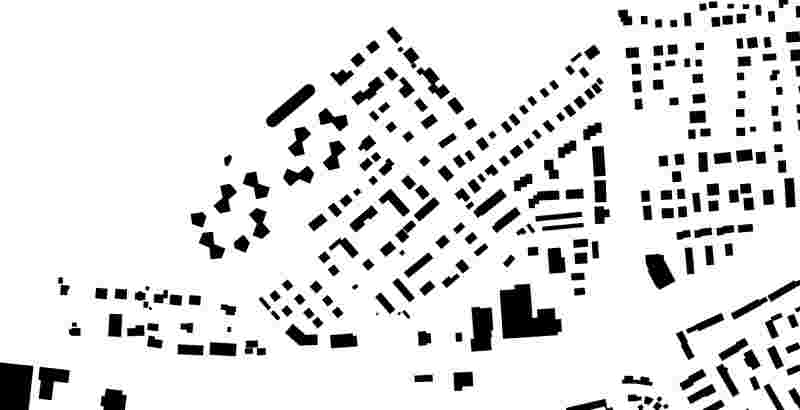
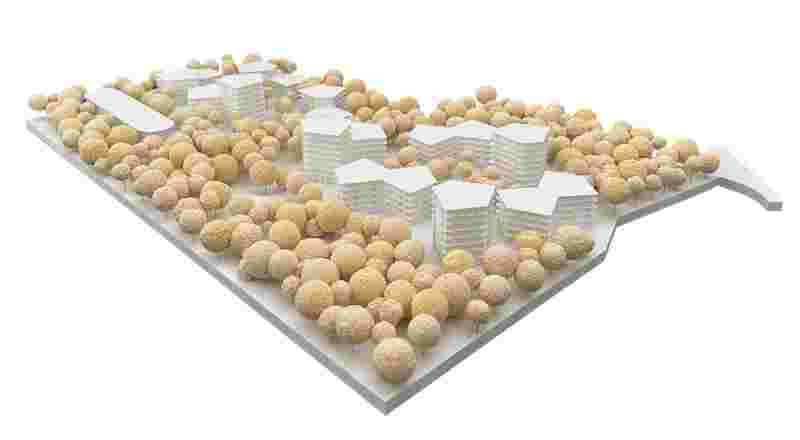
The former commercial site for concrete slabs extends west of Malchinger Straße, nestled in the immediately adjacent forest with its lush, old trees. The area lies at the transition between the surrounding green space and urban space, making it an important location at the entrance to Fürstenfeldbruck. It can be interpreted as a kind of existing clearing in the forest. The existing open space will be developed with two sub-quarters joined by polygonal structures. Inside the two quarters, light tree groves will create a cohesive, neighbourly space. At the same time, these neighbourhood groves are connected to the surrounding forest via openings between the coupled individual building blocks. New living space is to be created here in a compact, space-saving and sustainable design that blends in with the existing residential development of the Neulindach neighbourhood and creates new infrastructure and public spaces for Fürstenfeldbruck.
CONCEPT
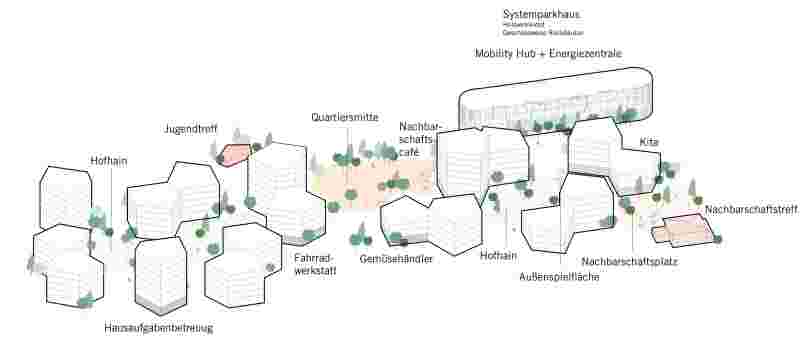
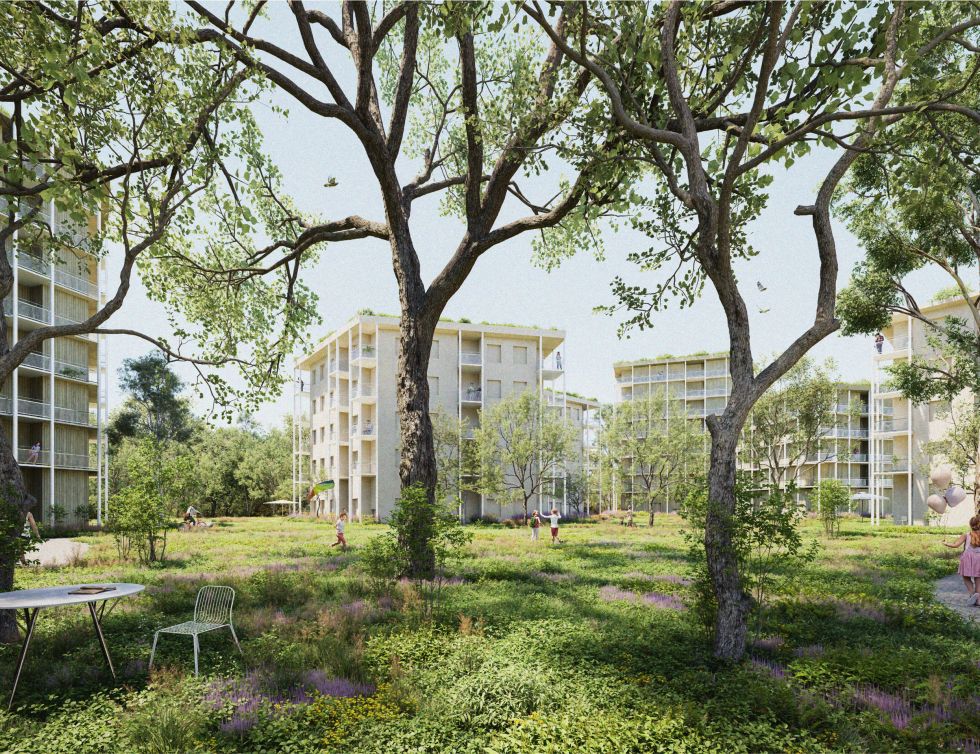
The planning area focuses primarily on the currently sealed open space in the south in order to preserve as many of the trees worthy of protection on the northern edge of the competition area as possible. Newly inserted polygonal building volumes are to be constructed between the forest in the north and the neighbourhood woods in the south. This allows for construction with minimal impact on the existing natural environment. The forest surrounds the individual buildings and blends with the new residential area to form a harmonious whole. The neighbourhood is not directly exposed to Malchinger Straße in terms of construction, but rather retreats behind the first row of trees, as it were. Only the existing building at the southern end of the perimeter opens onto Malchinger Straße. This building houses a neighbourhood meeting place, which connects the new development to the existing neighbourhood. By rotating and shifting the polygonal-shaped standardised houses, two green courtyards lined with trees are created, inviting residents to play or linger. The light tree groves in their interior create a coherent neighbourhood space that stretches from west to east. Diagonally across from this, a green network of newly planted trees and a cycle path connects the southern neighbourhood forest with the surrounding northern forest.The neighbourhood square (north) and a forest lake (south) are also located along this connection. The lake serves to drain roof and surface water and forms a relevant natural habitat for local flora and fauna at the interface between the two neighbourhoods.